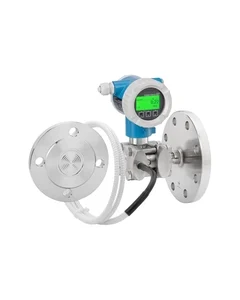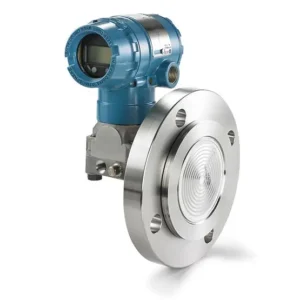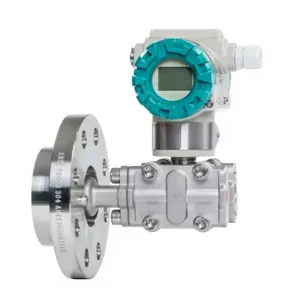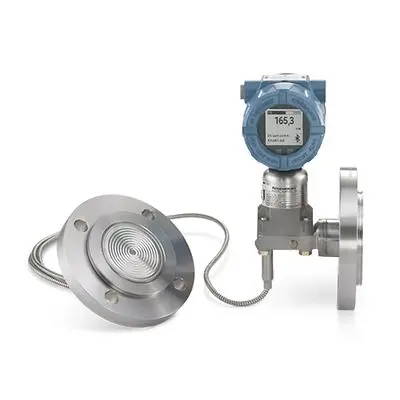
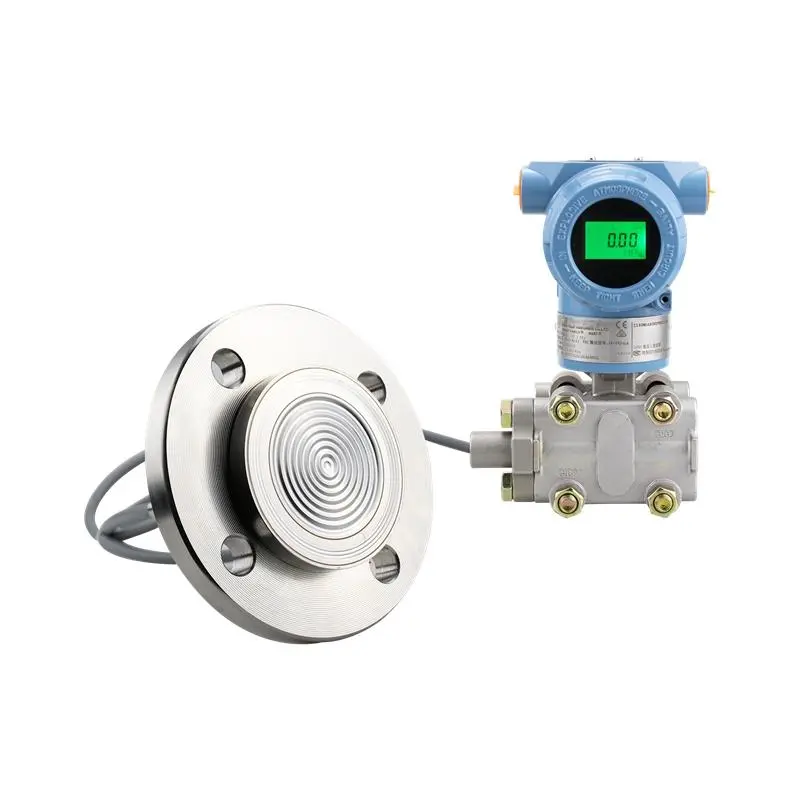
Capillary Differential Pressure Transmitter
A capillary differential pressure transmitter is a diaphragm seal DP level instrument that uses a filled capillary to separate the transmitter body from the flange-mounted diaphragm seal. It is designed for tank level measurement and other pressure measurement applications involving high temperature, corrosive media, viscous fluids, crystallizing media or restricted installation space.
It is typically composed of a differential pressure transmitter body, a single flange diaphragm seal assembly, a capillary remote seal system, and internal fill fluid, enabling continuous and stable level measurement under complex process conditions.
Compared with a single flange direct-mount structure, the capillary type separates the measuring diaphragm from the transmitter body. The purpose of this design is usually to mount the flange diaphragm at a high-temperature or space-limited measuring point, while installing the transmitter body at a location more suitable for observation, wiring, and maintenance.
- Pressure Type: Gauge Pressure, Absolute Pressure, Differential Pressure, Level
- Pressure Range:
- -1 bar to 30 bar, 0~300mH2O
- Accuracy: ±0.075%, ±0.2%
- Output Signal: 4–20 mA / HART
- Process Connection: DN20 / DN25 / DN40 / DN50 / DN65 / DN80 / DN100 / DN150 (customized available)
- Diaphragm Material: SS316L, HC-276, Tantalum, Gold-plated
- Capillary length: 1-10 meters (length can be customized upon request)
- Power Supply: 12–36 VDC
- Protection Rating: IP65 / IP67
- OEM Service: Available. The transmitter can be supplied with your company name and logo on the nameplate.
- Packaging: Individual carton box with protective foam.
- Weight: Approx. 6 kg per unit.
- Port of Shipment: Shanghai or Ningbo Port, China.
- Delivery Time: 3-7 working days.
- Transportation: Air freight, sea freight, or express delivery.
- Documentation: Certificate of Conformity (COC); Inspection / Test Report; Packing List; Commercial Invoice
Accessories for Capillary DP Level Transmitters
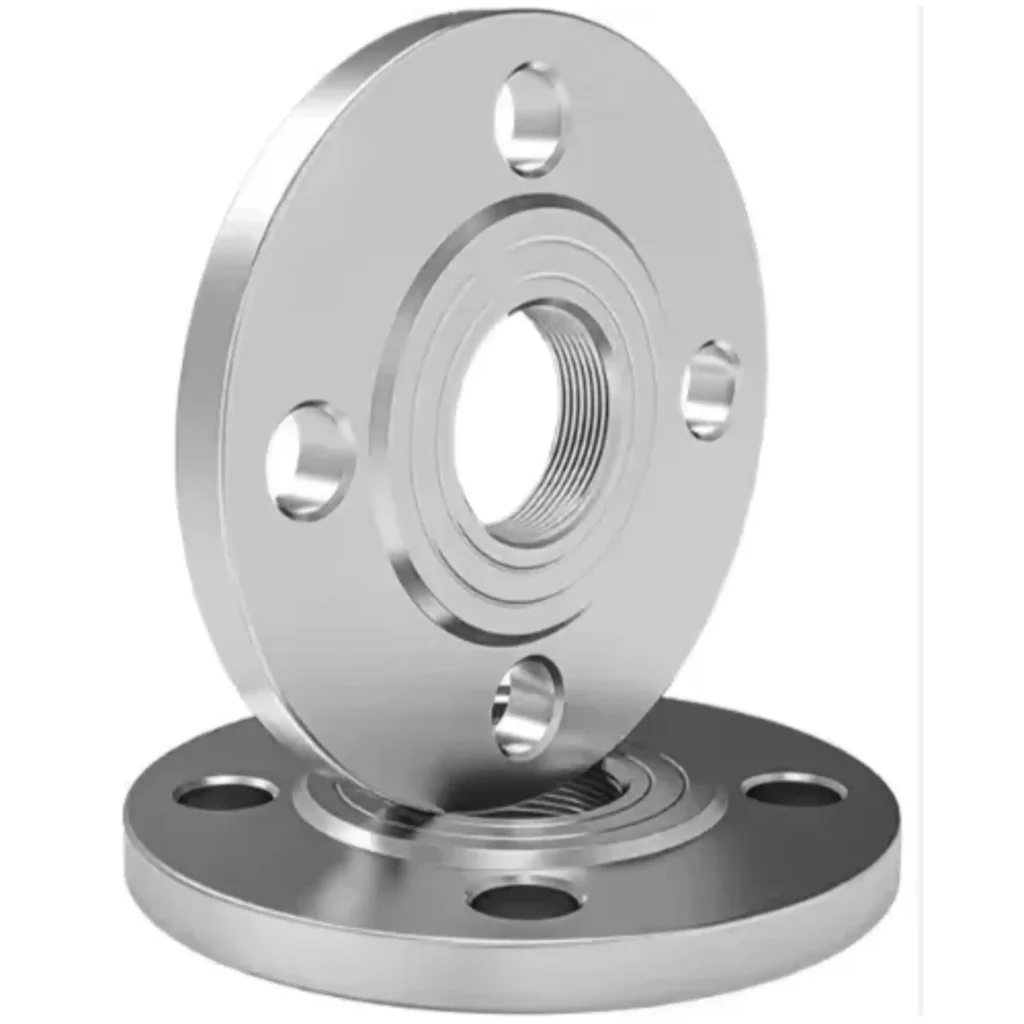
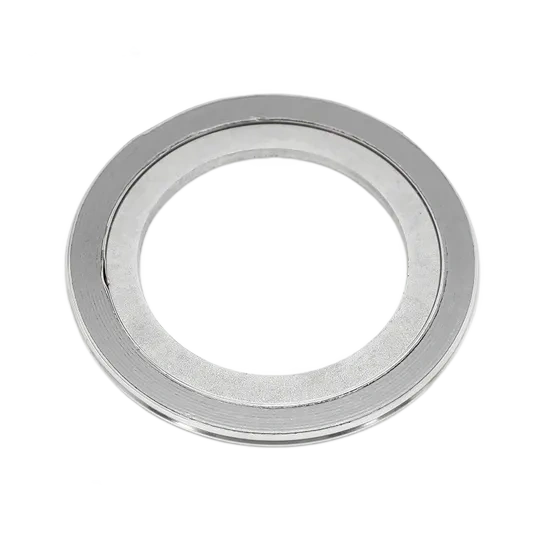
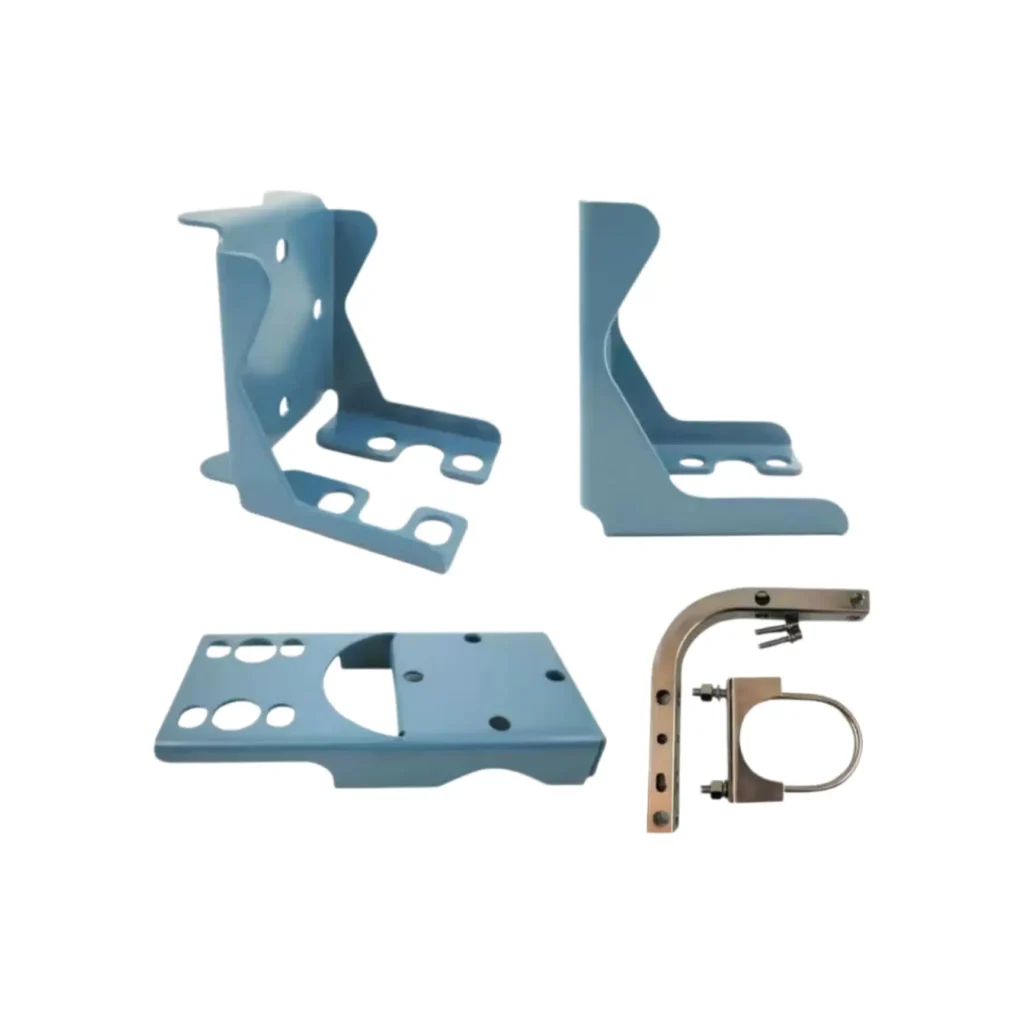
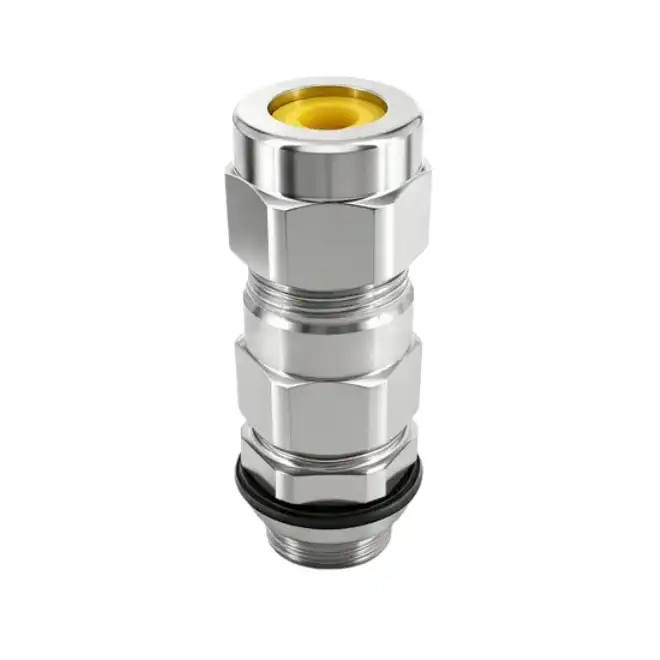
Table of Contents
Capillary Differential Pressure Transmitter Overview
1. What Is a Capillary Differential Pressure Transmitter?
A capillary differential pressure level transmitter is essentially a differential pressure level measuring instrument with a single-side diaphragm seal and capillary remote seal structure.
It still belongs to the category of differential pressure level measurement solutions, but unlike a standard single flange direct-mount design, the flange diaphragm seal assembly is not mounted directly on the transmitter body. Instead, it is connected to the transmitter through a capillary.
There are three key concepts involved here:
Single Flange
This means that the process connection uses a single-side flange diaphragm seal assembly. The isolation diaphragm is in direct contact with the process medium and is used to sense process pressure.
Capillary
This refers to the remote transmission system that connects the flange diaphragm seal assembly and the transmitter body. The capillary is filled with a special fill fluid, which stably transfers the pressure applied to the diaphragm to the transmitter sensor.
Differential Pressure Level
This means that the liquid level is not measured directly as a height. Instead, based on the hydrostatic pressure principle, the pressure difference is converted into liquid level.
Many users confuse this product with a conventional single flange level transmitter. In fact, the biggest difference between the two is:
In a direct-mount design, the diaphragm and the transmitter body are connected together, while in a capillary type, the two are installed separately.
Therefore, a single flange capillary differential pressure transmitter is more suitable for applications where direct mounting is inconvenient, temperature is high, vibration is significant, or the transmitter body needs to be installed more flexibly.
2. Structure and Diagram of A Single Flange Capillary Differential Pressure Transmitter
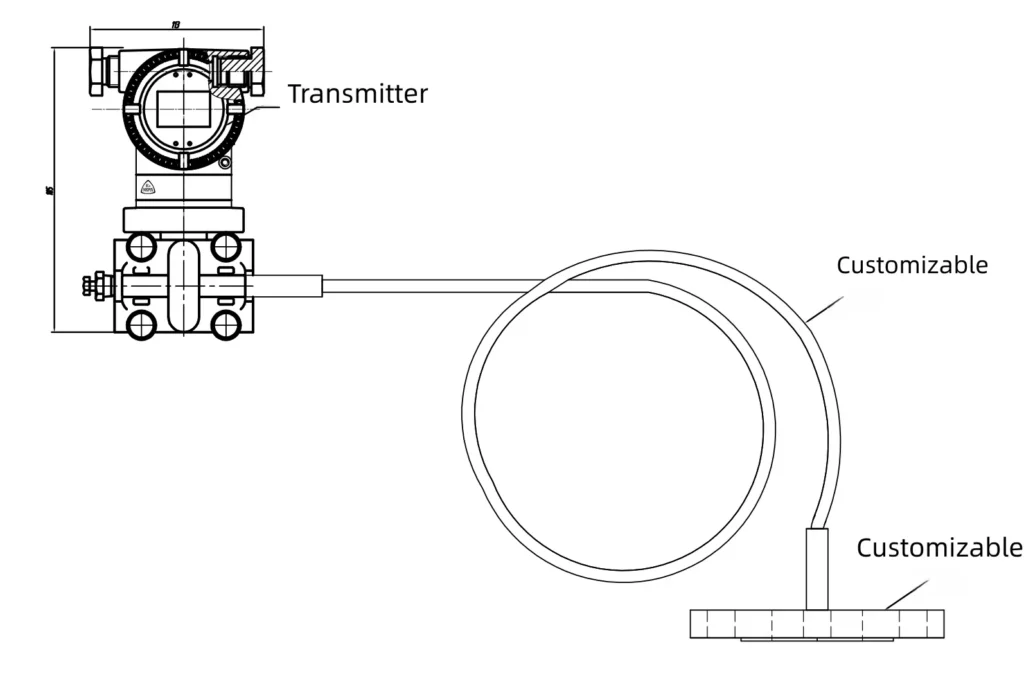
A single flange capillary differential pressure transmitter typically consists of the following parts:
Differential Pressure Transmitter Body
This is the core electronic and sensing unit of the product. It receives the pressure signal transmitted through the capillary and outputs a standard industrial signal. The common appearance is usually based on a 3051-style industrial structure, which is convenient for field installation and maintenance.
Single Flange Diaphragm Seal Assembly
Installed at the measuring point on the vessel, this part is in direct contact with the medium. Its function is to isolate the measured medium from the sensitive internal components of the instrument, preventing corrosion, clogging, or contamination of the sensor.
Capillary Remote Seal System
This connects the flange diaphragm seal assembly to the transmitter body and is the key part of the single flange capillary structure. The capillary is filled with fill fluid, which transmits the pressure signal and also allows the transmitter body to be installed away from a high-temperature or confined location.
Internal Fill Fluid
The fill fluid is used to transfer the pressure sensed by the diaphragm stably to the sensor. Different operating conditions require different types of fill fluid, especially in high-temperature or low-temperature service.
Flanged Process Connection
This is used to install the diaphragm seal assembly onto the tank, vessel, or equipment connection. Flange size, standard, pressure rating, and sealing face can usually be customized according to project requirements.
Mounting Bracket
Used to secure the transmitter body, making the installation more stable and facilitating later inspection and wiring.
Display Head and Electrical Connection
Some models can be equipped with an LCD display head for direct on-site reading of level, percentage, current, or pressure parameters. Electrical connection options commonly include M20×1.5 and 1/2-14 NPT.
3. Capillary Differential Pressure Transmitters Working Principle
The working principle of a capillary differential pressure transmitter is still based on the hydrostatic pressure principle.
As the liquid level rises, the flange diaphragm seal assembly installed at the lower side or lower section of the vessel senses a greater hydrostatic pressure.
This pressure first acts on the isolation diaphragm, then is transferred through the fill fluid inside the capillary to the differential pressure transmitter body, and finally is converted by the electronics module into a standard output signal, such as 4–20 mA or HART communication.
In other words, the pressure transmission path of this type of product is usually:
Process pressure → isolation diaphragm → fill fluid → capillary → transmitter sensor → electrical output
One important point must be noted: the capillary does not transmit an electrical signal. It transmits pressure through the fill fluid.
Therefore, capillary length, fill fluid type, installation position, and ambient temperature can all affect measurement performance.
In actual level measurement applications, liquid level is not directly entered into the transmitter. Instead, it must be calculated based on the following parameters:
- Medium density
- Liquid level height
- Installation position
- Process pressure condition
- Capillary structure
That is why, when requesting a quotation for this type of product, it is not enough to provide only “how many meters of level.” The medium, temperature, density, and installation conditions must also be confirmed.
4. Applications of Capillary DP Level Transmitter
A capillary differential pressure transmitter is commonly used in the following industries:
- Chemical industry.
- Petrochemical industry.
- Pharmaceutical industry.
- Food and beverage industry.
- Fermentation systems
- Water treatment.
- Environmental protection.
- Tank farms and storage areas.
- Various process vessel level measurement systems.
It is especially widely used where process conditions are complex, media properties are challenging, and installation environments are less than ideal.
5. Why Choose a Capillary Remote Seal Structure?
Many users ask the same question when they first encounter this type of product:
If a single flange direct-mount transmitter can also measure level, why use a capillary type?
The answer usually lies in the site conditions.
To Prevent High Temperature from Reaching the Transmitter Body Directly
When the flange measuring point temperature is high, directly mounting the transmitter body there may affect the long-term stability and life of the electronics module. The capillary structure allows the body to be installed in a lower-temperature location.
To Improve Installation and Maintenance Convenience
The flange diaphragm can be installed at the vessel measuring point, while the transmitter body can be installed at a location more convenient for observation, wiring, and maintenance.
To Increase Installation Flexibility
For narrow spaces, restricted orientations, or structurally complex equipment, the capillary structure is easier to adapt to field installation requirements.
To Suit More Complex Process Environments
In applications involving vibration, heat tracing, radiant heat, or structural interference, a capillary remote seal is usually a more reliable choice.
So the capillary type is not intended to make the product “more complicated.” It is designed to solve problems that are difficult to address with a direct-mount type.
Technical Specifications and Selection Guide of Capillary Differential Pressure Transmitter
1. Technical Specifications of Capillary Differential Pressure Transmitter
| SIY3051C Diaphragm Seal Differential Pressure Level Transmitter Selection Table | ||||
| 10 | Transmitter type | |||
| D | Differential pressure transmitter | |||
| G | Gauge pressure transmitter | |||
| A | Absolute pressure transmitter | |||
| 20 | Accuracy | |||
| -H | Basic error ±0.075% | |||
| -N | Basic Error ±0.2% | |||
| 30 | Pressure Range | |||
| 3051CD Differential pressure | ||||
| 3 | -6kPa~6kPa(-60mbar~60mbar) | |||
| 4 | -40kPa~40kPa(-400mbar~400mbar) | |||
| 5 | -250kPa~250kPa(-2.5bar~2.5bar) | |||
| 6 | -1MPa~1MPa(-10bar~10bar) | |||
| 7 | -3MPa~3MPa(-30bar~30bar) | |||
| 9 | Other agreed pressure ranges | |||
| 3051CG Gauge pressure | ||||
| 3 | -6kPa~6kPa(-60mbar~60mbar) | |||
| 4 | -40kPa~40kPa(-400mbar~400mbar) | |||
| 5 | -100kPa~250kPa(-1bar~2.5bar) | |||
| 6 | -0.1MPa~1MPa(-1bar~10bar) | |||
| 7 | -0.1MPa~3MPa(-1bar~30bar) | |||
| 8 | -0.1MPa~10MPa(-1bar~100bar) | |||
| 9 | -0.1MPa~21MPa(-1bar~210bar) | |||
| 10 | -0.1MPa~40MPa(-1bar~400bar) | |||
| 3051CA Absolute pressure | ||||
| 4 | 0~40kPa(0~0.4bar) | |||
| 5 | 0~250kPa(0~2.5bar) | |||
| 6 | 0~3MPa(0~30bar) | |||
| 9 | Other agreed pressure ranges | |||
| Note: 3051CD static pressure: 16 MPa / 25 MPa / 40 MPa | ||||
| 40 | Communication Protocol | |||
| H | 4–20 mA + HART5/HART6/HART7 communication protocol | |||
| M | RS485 Modbus communication protocol | |||
| 50 | Diaphragm material | |||
| 2 | 316 stainless steel | |||
| 3 | Hastelloy C-276 | |||
| 4 | Monel | |||
| 5 | Tantalum (only for 3051CD & CG, range 4-9, not for 3051CA) | |||
| 6 | Gold-plated | |||
| 0 | Customer-specified diaphragm material | |||
| 60 | Process connection | |||
| S1 | One remote flange | |||
| S2 | Two remote flanges | |||
| 70 | Wetted seal material | |||
| N | Nitrile rubber (NBR) | |||
| F | Fluoroelastomer (FKM) | |||
| P | PTFE (Polytetrafluoroethylene) | |||
| 80 | Fill fluid | |||
| 1 | Silicone oil | |||
| 2 | Fluorinated oil | |||
| 90 | Display | |||
| N | None | |||
| L | LCD display (-20°C) | |||
| O | OLED display (-40°C) | |||
| 100 | Housing material & electrical connection | |||
| B | Aluminum alloy housing, electrical connection M20×1.5 | |||
| S | Aluminum alloy housing, electrical connection 1/2 NPT | |||
| C | Stainless steel housing, electrical connection M20×1.5 | |||
| T | Stainless steel housing, electrical connection 1/2 NPT | |||
| 110 | Connection accessories | |||
| 3M | 3-valve manifold | |||
| 5M | 5-valve manifold | |||
| 2F | 1/2 NPT oval flange | |||
| 120 | Mounting bracket option | |||
| N | None | |||
| 1 | Galvanized carbon steel bracket | |||
| 2 | Stainless steel bracket | |||
| 130 | Hazardous area certification | |||
| E5 | Intrinsic safety ia IIC T4-T6 | |||
| K5 | Explosion-proof d IIC T4-T6 | |||
| 140 | Other options | |||
| Q4 | Factory calibration certificate | |||
| Q3 | Third-party calibration certificate | |||
| V6 | Suitable for full vacuum service | |||
| J1 | NAMUR NE43 standard | |||
| J3 | Built-in lightning protection module | |||
| T1 | Oil-free degreasing | |||
| C1 | SIL3 certification (for HART communication type only) | |||
| 150 | Remote seal assembly options for diaphragm pressure transmitter (Note: -1199 option) | |||
| RFW | Remote flange type seal | |||
| EFW | Extended flange type seal | |||
| FFW | Flush flange type seal | |||
| PFW | Flat type seal | |||
| SCW | Sanitary type seal | |||
| RTW | Remote threaded type seal | |||
| 160 | Flange rating & material | Flange size | Pressure rating | Material |
| A21 | DN50/2″ | 150Ib | 304SST | |
| B21 | DN50/2″ | 150Ib | 316SST | |
| A31 | DN80/3″ | 150Ib | 304SST | |
| B31 | DN80/3″ | 150Ib | 316SST | |
| A41 | DN100/4″ | 150Ib | 304SST | |
| B41 | DN100/4″ | 150Ib | 316SST | |
| A22 | DN50/2″ | 300Ib | 304SST | |
| B22 | DN50/2″ | 300Ib | 316SST | |
| A32 | DN80/3″ | 300Ib | 304SST | |
| B32 | DN80/3″ | 300Ib | 316SST | |
| A42 | DN100/4″ | 300Ib | 304SST | |
| B42 | DN100/4″ | 300Ib | 316SST | |
| A24 | DN50/2″ | 600Ib | 304SST | |
| B24 | DN50/2″ | 600Ib | 316SST | |
| A34 | DN80/3″ | 600Ib | 304SST | |
| B34 | DN80/3″ | 600Ib | 316SST | |
| A44 | DN100/4″ | 600Ib | 304SST | |
| B44 | DN100/4″ | 600Ib | 316SST | |
| YY | Other agreed special size, pressure rating, or material | |||
| 170 | Diaphragm material | |||
| D4 | 316L | |||
| D6 | Hastelloy | |||
| E0 | Tantalum | |||
| F0 | Monel | |||
| P | With PTFE/PFA coating | |||
| G | Gold-plated coating | |||
| Z | Other agreed special requirements | |||
| 180 | Insertion tube (for EFW extended flange type seal only) | |||
| Insertion length | Tube material | |||
| EC0 | Special custom | Special custom | ||
| ES1 | 50mm | 316L | ||
| ES2 | 100mm | 316L | ||
| ES3 | 150mm | 316L | ||
| EP1 | 50mm | 316L+PTFE/PFA | ||
| EP2 | 100mm | 316L+PTFE/PFA | ||
| EP3 | 150mm | 316L+PTFE/PFA | ||
| EH1 | 50mm | HC-276 | ||
| EH2 | 100mm | HC-276 | ||
| EH3 | 150mm | HC-276 | ||
| 190 | Pressure connection port (for RTW remote threaded type seal only) | |||
| A | 1/4–18 NPT | |||
| C | 3/8–18 NPT | |||
| D | 1/2–14 NPT | |||
| H | 1–111/2 NPT | |||
| H | 11/2–111/2 NPT | |||
| 200 | Seal fill fluid | Temperature limit | ||
| A | Syltherm XLT | -100 to 300℉ (-73 to 135℃) | ||
| C | High-temperature silicone oil | 60 to 572℉ (15 to 300℃) | ||
| D | D.C. Silicone 200 | -40 to 400℉ (-40 to 205℃) | ||
| H | Inert oil (fluorinated oil) | -50 to 350℉ (-45 to 177℃) | ||
| 210 | Capillary length | |||
| □□ | Agreed capillary length, from 1–15 m (e.g. 2 m: 02) | |||
| 220 | Capillary armor material | |||
| P | 304+PVC | |||
| 230 | Other options | |||
| T1 | Oil and grease removal | |||
| V6 | Vacuum-resistant treatment | |||
| Z | Other agreed special requirements | |||
| Note: When selecting a dual-flange DP level transmitter, if the high-pressure and low-pressure side seals are different, select from the high-pressure side first. | ||||
2. How to Select a Suitable Single-Flange Capillary Differential Pressure Level Transmitter?
First Determine Whether a Capillary Structure Is Necessary
If the measuring point is hot, installation space is limited, wiring is inconvenient, or the transmitter body must be located away from a heat source, a capillary type is usually more suitable.
Convert Liquid Height and Density into Differential Pressure Range
Liquid level height is only the surface parameter. In actual selection, it still has to be converted into a differential pressure value.
Select Fill Fluid and Structure According to Process Temperature
The capillary type is better suited for high-temperature service, but only if the fill fluid and structural design are selected correctly.
Choose Diaphragm Material According to Corrosiveness
316L is suitable for most general media, but strongly corrosive applications often require higher-grade materials.
Determine Capillary Length According to Installation Distance
The length should meet field installation requirements, but longer is not always better.
Choose Output Functions According to System Requirements
If remote configuration and diagnostics are needed, HART communication can be considered.
3. Relationship Between Capillary Length and Measurement Performance
Capillary length is a critical factor for single flange capillary products.
Many people assume that as long as the site allows installation, a longer capillary always means greater flexibility. In fact, this is not the case.
As capillary length increases, it usually brings the following effects:
- Slower response speed
- Greater sensitivity to ambient temperature
- More complicated installation layout
- Greater dependence of zero stability on installation quality
Therefore, as long as installation and maintenance requirements are met, it is usually recommended to keep the capillary length within a reasonable range rather than making it unnecessarily long.
4. Common Diaphragm Materials for Single Flange Differential Pressure Level Transmitters
316L Stainless Steel
316L is the most common standard wetted material used in single flange differential pressure level transmitters. It is suitable for most conventional liquid media and general industrial operating conditions. For non-strongly corrosive media such as water, oil, and general chemical liquids, 316L is usually sufficient, while also offering good cost-effectiveness and shorter lead times.
Hastelloy
Hastelloy is suitable for more corrosive chemical media. In particular, it provides better corrosion resistance than 316L in certain acidic, chloride-containing, or otherwise complex corrosive environments. When 316L cannot provide long-term compatibility, a Hastelloy diaphragm should be considered first, although the final selection still needs to be confirmed according to the medium composition, concentration, and temperature.
Tantalum Diaphragm
Tantalum offers excellent corrosion resistance and is commonly used in highly corrosive service conditions, especially where very high diaphragm corrosion resistance is required. However, tantalum is not suitable for all media. It is generally not recommended for strong alkalis and some special corrosive systems, so the final selection should always be based on the specific process conditions.
Monel
Monel provides good corrosion resistance in certain special chemical media, especially in some fluorine-containing media, hydrofluoric acid, and other demanding service conditions. It is not usually the first choice for conventional media, but is typically used in applications with clearly defined corrosion-resistance requirements.
PTFE Corrosion-Resistant Structure
A PTFE corrosion-resistant structure is suitable for a wide range of acidic, alkaline, and highly corrosive media. It offers clear advantages in applications where conventional metal diaphragms cannot provide sufficient corrosion resistance. For strongly corrosive media, a PTFE-based protection solution is often a more reliable choice, although temperature, pressure, and installation design must also be taken into account.
Gold-Plated Diaphragm
Gold-plated diaphragms are commonly used for special media such as hydrogen service. They can effectively reduce hydrogen permeation and the risk of hydrogen embrittlement, thereby improving long-term operating reliability. This type of solution is generally used as a special option for specific operating conditions rather than as a standard configuration.
Diamond Diaphragm
Diamond diaphragms are typically used in service conditions involving strong corrosion, solid particles, or severe wear in the process medium. They have already been proven suitable for black water applications.
Material Selection Recommendation
Diaphragm material selection should not be based on price alone. More importantly, the material must be compatible with the actual process medium and operating conditions. A proper selection should take into account the medium composition, concentration, temperature, pressure, and corrosion characteristics. On this basis, cost, lead time, and long-term operating stability should then be evaluated together.
Installation and Maintenance of Capillary Differential Pressure Transmitters
1. How to Install a capillary differential pressure transmitter?
Correct installation directly affects the measurement accuracy, stability, and service life of a diaphragm seal level transmitter.
1) Check before installation
- Confirm whether the model is correct
- Confirm whether the measuring range matches the application
- Confirm whether the flange specification is compatible
- Confirm whether the diaphragm surface is intact
2) Avoid diaphragm damage
The isolating diaphragm is the key pressure-sensing component. During transportation, unpacking, and installation, it must not be dented, squeezed, or scratched by hard objects. It is best to gently press the diaphragm with a finger to check whether it has elasticity. If the diaphragm does not move when pressed, contact the manufacturer directly.
3) Position the gasket correctly
The gasket provides sealing and helps prevent medium leakage, so it must be installed correctly. At the same time, care must be taken to ensure that the gasket does not press against the diaphragm, otherwise zero shift may occur. PTFE gaskets are commonly used, but if the process temperature is too high, a spiral wound gasket should be used instead.
4) Tighten the fasteners properly
The transmitter flange is usually not welded to the mating flange on the equipment. In most cases, the two flanges are connected by bolts and other fasteners. Therefore, whether the bolts are tightened properly has a direct effect on both measurement performance and whether the medium may leak.
5) Fix the transmitter head properly
Use a flat mounting bracket or an L-shaped bracket to secure the transmitter head to a 2-inch pipe. The installation position should be convenient for on-site personnel to observe and commission the transmitter.
6) Wire correctly
In most cases, only the positive and negative power wires need to be connected to the corresponding terminals of the transmitter. Incorrect wiring may lead to unexpected problems.
7) Check zero before commissioning
After installation, the zero point should be checked whenever conditions allow.
In practice, it is common for customers to position the gasket incorrectly during installation, causing it to press against the diaphragm and resulting in zero shift. In this case, the transmitter can be removed and installed again correctly. If removal is not possible, the zero can be recalibrated. However, this is only a temporary corrective measure and is not suitable for long-term measurement.
2. Common Faults and Troubleshooting of a Capillary Differential Pressure Transmitter
No Output Signal
If the capillary differential pressure transmitter has no output signal, first check whether the power supply is normal, whether the wiring is correct, whether the polarity is reversed, and whether the signal loop is complete.
After confirming that the external electrical conditions are normal, the next step is to inspect the electronic module, wiring terminals, and the capillary differential pressure transmitter itself for any abnormalities.
Output Too High or Too Low
If the output value of the capillary level transmitter is obviously too high or too low, the first items to check are the range setting, zero suppression or elevation, and overall parameter configuration.
In addition, incorrect medium density settings, changes in installation position, or differences between the actual field conditions and the configured conditions may also cause significant measurement deviation.
Signal Fluctuation
Unstable or fluctuating signals from a diaphragm seal remote differential pressure level transmitter are often caused by mechanical vibration, ambient temperature changes, electromagnetic interference, insufficient mounting support, or poor capillary fixing.
When this happens, the installation condition, nearby equipment operation, and cable routing environment should all be checked together.
Zero Drift
Zero drift in a capillary differential pressure level transmitter is usually related to long-term exposure to high temperature, improper fill fluid selection, or performance changes after extended operation.
If the operating temperature varies significantly, or if the fill fluid is not suitable for the application, zero stability may be affected. For this reason, these factors should be considered carefully during the selection and installation stages.
Slow Response
If the response of the capillary differential pressure transmitter becomes noticeably slow, possible causes include excessive capillary length, improper fill fluid selection, or low ambient temperature.
Especially in low-temperature service or with long capillaries, the pressure transmission speed of the fill fluid may be affected, which can result in a slower overall response.
Capillary Differential Pressure Transmitter Comparison
1. Single Flange Capillary Differential Pressure Level Transmitter VS Single Flange Direct Mount Differential Pressure Level Transmitter
Single Flange Capillary Differential Pressure Level Transmitter:
- It uses a capillary tube to separate the diaphragm seal from the transmitter body, making it suitable for applications where the transmitter needs to be installed away from high temperatures or in restricted mounting positions.
- It is better suited for high-temperature media, tight installation spaces, or applications where on-site observation and maintenance are inconvenient.
- Under complex process conditions or limited installation space, the capillary design usually provides greater flexibility and is easier to adapt to field layout requirements.
Single Flange Direct Mount Differential Pressure Level Transmitter:
- The transmitter body is directly connected to the flange diaphragm seal, resulting in a simpler overall structure.
- It generally offers lower cost, faster response, and more straightforward installation.
- It is better suited for applications with moderate temperatures, good installation conditions, and relatively simple process requirements.
2. Single Flange Capillary Differential Pressure Level Transmitter VS Dual Flange Differential Pressure Level Transmitter
Single Flange Capillary Differential Pressure Level Transmitter:
- It is mainly used for single-side diaphragm seal isolation while also allowing the transmitter body to be mounted away from the heat source in high-temperature applications.
- It is better suited for level measurement where the reference side condition is clear and only the measuring side requires diaphragm seal isolation.
- If the main challenge on site is high temperature, limited installation space, or difficulty in direct mounting, a single flange capillary solution is usually sufficient.
Dual Flange Differential Pressure Level Transmitter:
- Both the high-pressure side and low-pressure side use diaphragm seal structures, making it suitable for applications where both sides require isolation.
- It is better suited for closed tanks, pressurized vessels, and applications where top pressure has a clear influence on level measurement.
- When level measurement requires top pressure compensation, isolation of both upper and lower tapping points, and handling of complex media, a dual flange solution is usually more complete.
3. Single Flange Capillary Differential Pressure Level Transmitter VS Submersible Level Transmitter
Single Flange Capillary Differential Pressure Level Transmitter:
- It is better suited for industrial process level measurement, especially in applications involving high temperature, corrosive media, viscous media, or complicated installation conditions.
- With its flange connection and diaphragm seal design, it usually provides better durability and stronger process adaptability.
- In industrial environments that require long-term stable operation and a more engineered installation approach, it is usually the more reliable option.
Submersible Level Transmitter:
- It has a simple structure, easy installation, and usually lower overall cost.
- It is better suited for open pits, water tanks, clean liquids, and atmospheric applications.
- In general level monitoring applications, it is usually a more lightweight and economical solution.
4. Single Flange Capillary Differential Pressure Level Transmitter VS Radar Level Meter
Single Flange Capillary Differential Pressure Level Transmitter:
- It is a contact-type level measurement solution that calculates level based on pressure or differential pressure.
- In high-temperature, pressurized, or space-limited applications where the transmitter body should not be installed close to the measuring point, the capillary structure offers clear advantages.
- This is a mature and widely used industrial solution, especially for applications with special installation requirements.
Radar Level Meter:
- It is a non-contact measurement solution and does not come into direct contact with the medium.
- It is better suited for applications where wetted contact is not desired and continuous level measurement is required from the top of the tank.
- Under suitable installation conditions and with media that provide good signal reflection, radar level meters can offer a convenient non-contact measurement solution.
5. Single Flange Capillary Differential Pressure Level Transmitter VS Ultrasonic Level Meter
Single Flange Capillary Differential Pressure Level Transmitter:
- It is a contact-type measurement solution and usually provides better stability in complex industrial conditions.
- It is generally less dependent than ultrasonic solutions on factors such as steam, foam, temperature variation, and installation space.
- However, this type of transmitter does require proper selection, installation position, and capillary routing, so it should be designed according to actual process conditions.
Ultrasonic Level Meter:
- It is a non-contact level measurement solution with relatively flexible installation.
- It is better suited for applications with normal temperature, normal pressure, low steam, little foam, and sufficient installation space.
- Since it is more sensitive to steam, temperature, foam, and installation conditions, it is generally more suitable for relatively simple service conditions.
6. Single Flange Capillary Differential Pressure Level Transmitter VS Magnetic Level Gauge
Single Flange Capillary Differential Pressure Level Transmitter:
- It can provide a continuous standard electrical output signal, making it easy to connect to PLC, DCS, or other automation control systems.
- It is better suited for remote monitoring, automatic control, and applications requiring signal transmission.
- In applications involving high temperature, pressure, corrosive media, or restricted installation positions, it is usually better suited for system integration.
Magnetic Level Gauge:
- It provides intuitive on-site reading, allowing the liquid level to be observed directly.
- It is better suited for applications that require local indication, manual inspection, and simple level display.
- If the main requirement is local visual indication rather than continuous signal output and automatic control, a magnetic level gauge is usually the more direct solution.
OEM Service, Price, and Quotation Information About Capillary Differential Pressure Transmitter
1. Why Choose Our Single-Flange Capillary DP Level Transmitter?
SIY electric single-flange capillary DP level transmitters are based on a mature industrial transmitter platform and diaphragm seal technology. According to different applications, they can be flexibly configured with different flanges, diaphragm materials, capillary lengths, fill fluids, and output functions, balancing installation flexibility with long-term field reliability.
Our advantages mainly include:
- Mature structure suitable for long-term industrial service
- Support for various flange, material, and capillary configurations
- Support for high-temperature, corrosion-resistant, and sanitary solutions
- Support for 4–20 mA, HART, local display, and explosion-proof configurations
- Calibration and parameter setting before delivery
- Integrated support for selection, quotation, and technical service
- Suitable for engineering projects, equipment packages, and bulk purchasing
2. Do capillary differential pressure transmitter Support OEM / Private Labeling?
Yes.
Custom production can be arranged according to customer requirements. We can also print the customer’s logo and company name on the product nameplate, helping customers establish their own branded product line.
SIY Electric focuses on the research, development, and manufacturing of pressure transmitters, with more than 10 years of experience in industrial instrumentation production. We have been providing reliable and stable pressure measurement products to customers both domestically and internationally. The company has mature manufacturing processes, strict quality control procedures, and a well-established supply chain system. Our products are widely used in industries such as water treatment, petrochemical, energy, power generation, machinery, and industrial automation.
For OEM / ODM cooperation, we can provide customized services based on customer requirements, including:
- Flange standard customization
- Flange size and pressure rating customization
- Capillary length customization
- Diaphragm material customization
- Flange material customization
- Fill fluid customization
- Electrical connection customization
- Display head customization
- Nameplate and label customization
All products undergo strict performance testing and calibration before leaving the factory, ensuring measurement accuracy and long-term stability. With reliable product quality, stable delivery schedules, and professional technical support, we have established long-term OEM partnerships with many equipment manufacturers, engineering companies, and instrumentation distributors.
If you are looking for a stable and reliable pressure transmitter manufacturer or OEM supplier, please feel free to contact us. We will provide professional product solutions based on your specific requirements.
3. Price of Capillary Differential Pressure Transmitter
For the most conventional applications, such as normal temperature, normal pressure, 316L diaphragm, flange specification DN50 / PN16 / 304 material, and capillary length within 3 meters, the price is usually around USD 370.
The price of a capillary pressure transmitter is usually not determined by the transmitter body alone, but by the whole configuration.
Please send us your data sheet or detailed on-site operating conditions, and we will provide a quotation within one hour.
FAQ
How do I choose between a single flange capillary type and a direct-mount type?
If field temperature is not high, installation is convenient, and there is enough space, the direct-mount type is usually simpler. If the application is high temperature, installation is restricted, or the transmitter body must be away from the heat source, the capillary type is more suitable.
How long can the capillary be?
It can be customized according to installation distance, but unnecessarily excessive length is not recommended. As length increases, response speed and ambient temperature influence also become more significant.
Why is the capillary type commonly used in high-temperature service?
Because the capillary structure allows the transmitter body to be installed away from the heat source, reducing the impact of temperature on the electronics module.
Does the capillary affect accuracy?
With proper selection and correct installation, it can meet industrial field application requirements. However, capillary length, temperature environment, and installation method do influence measurement performance.
Does it support HART communication?
Yes. Common configurations are available with 4–20 mA plus HART communication.
Can it have a local display?
Yes. Some models support an LCD display for direct on-site viewing of level, percentage, current, or pressure parameters.