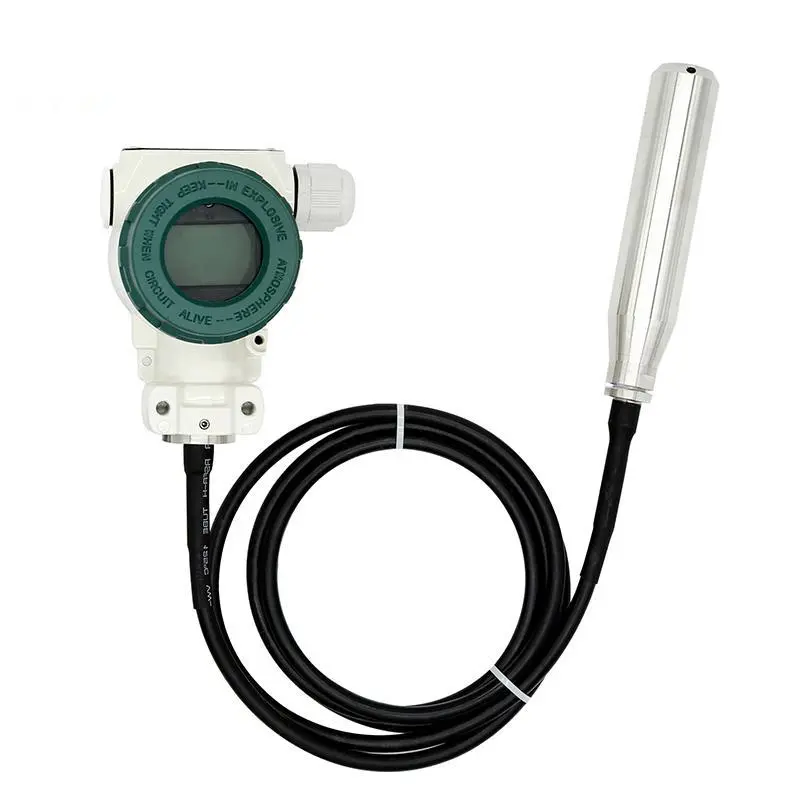
Submersible Level Transmitter
A submersible level transmitter is a level measuring instrument based on the hydrostatic pressure principle of liquids. It is directly immersed into the liquid, calculates the liquid level by detecting the pressure generated by the liquid column, and outputs standard signals such as 4–20 mA, HART, and RS485 for easy integration with PLC, DCS, and other automation control systems.
Our submersible level transmitters can be configured with different probe materials, vented cables, anti-corrosion structures, housing styles, display options, and output signals according to field conditions. They are suitable for continuous level monitoring of clean water, wastewater, groundwater, circulating water, mildly corrosive liquids, and some chemical liquids.
- Measure Type: Level
- Pressure Range: 0.3~100 mH2O
- Accuracy: ±0.5%, ±0.2%
- Output Signal: 4–20 mA / HART
- Process Connection: L-bracket / Flange mounting
- Diaphragm Material: SS316L, HC-276, Tantalum, Gold-plated
- Power Supply: 12–36 VDC
- Protection Rating: IP65 / IP67
- OEM Service: Available. The transmitter can be supplied with your company name and logo on the nameplate.
- Packaging: Individual carton box with protective foam.
- Weight: Approx. 1.5 kg per unit.
- Port of Shipment: Shanghai or Ningbo Port, China.
- Delivery Time: 3-7 working days.
- Transportation: Air freight, sea freight, or express delivery.
- Documentation: Certificate of Conformity (COC); Inspection / Test Report; Packing List; Commercial Invoice
Accessories for Submersible Level Transmitters
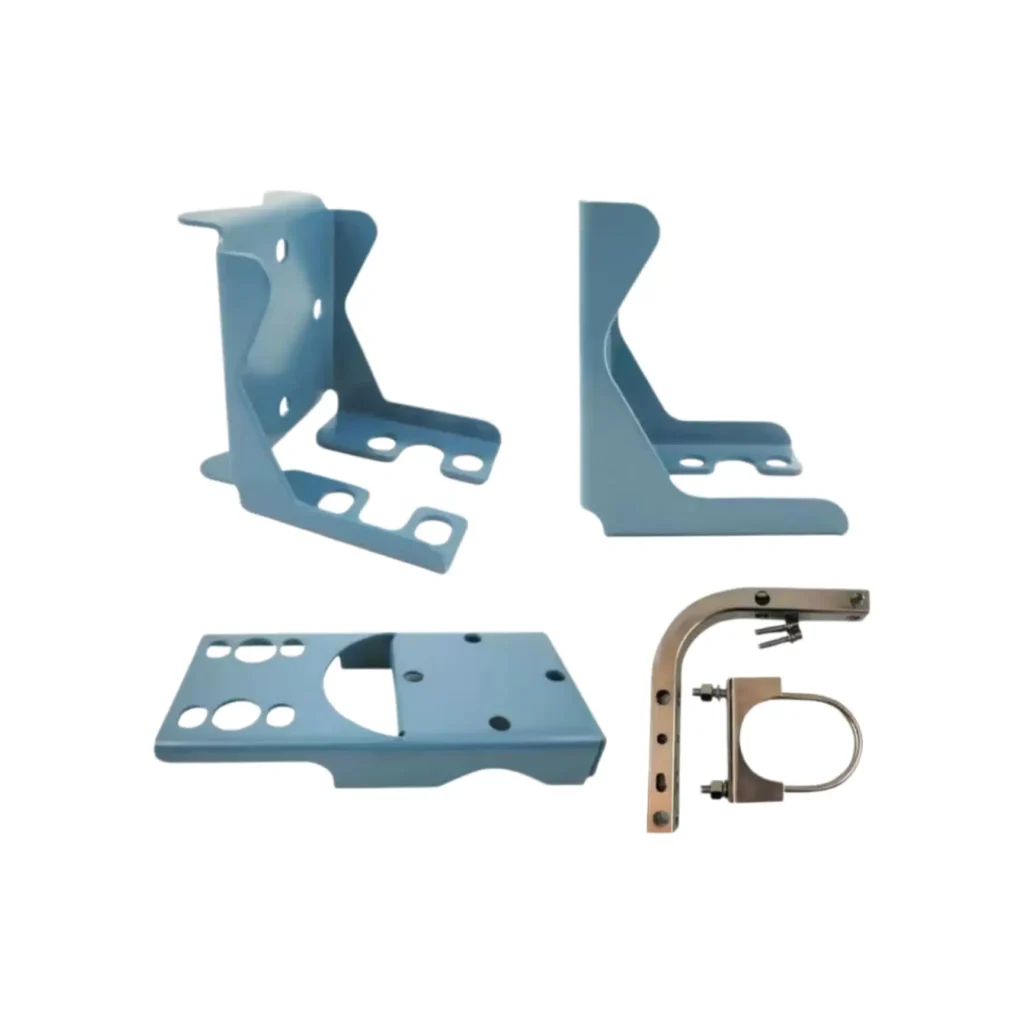
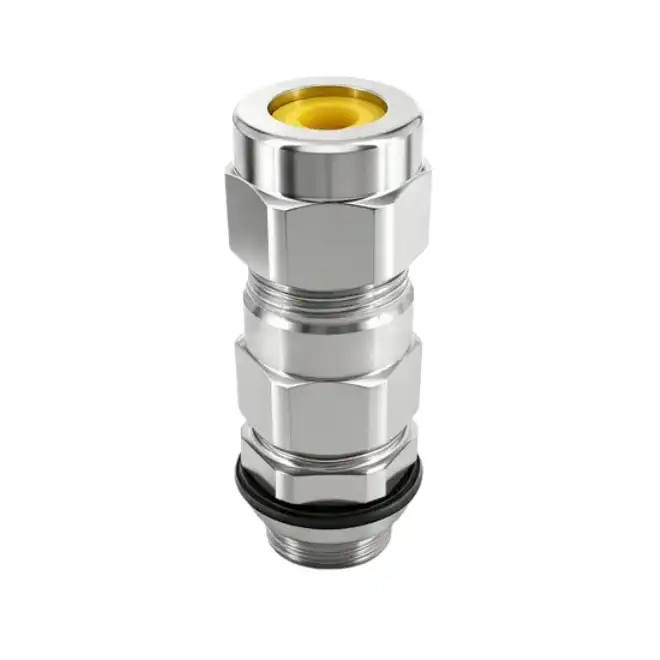


Table of Contents
Submersible Level Transmitter Overview
1. What Is a Submersible Level Transmitter?
A submersible level transmitter, also commonly called a hydrostatic level transmitter, is essentially a pressure measuring instrument used for level measurement applications.
Its measuring principle is straightforward: once the probe is immersed in the liquid, the position of the probe is subjected to the hydrostatic pressure generated by the liquid column. The higher the liquid level, the greater the pressure on the probe. By measuring this pressure and combining it with the liquid density, the instrument can calculate the corresponding liquid level height.
This type of product is widely used in:
- Water pools, tanks, and water towers.
- Deep wells, fire water tanks, and groundwater monitoring.
- Municipal water supply and drainage systems.
- Rivers, reservoirs, and hydrological monitoring.
- Wastewater treatment and environmental protection projects.
- General industrial storage tank level measurement.
- Mildly corrosive liquids or media requiring anti-corrosion design.
For many atmospheric, open tank, deep well, and pool applications, a submersible level transmitter is often a practical solution with a simple structure, easy installation, moderate cost, and stable long-term performance.
2. Structure and Diagram of Submersible Level Transmitter
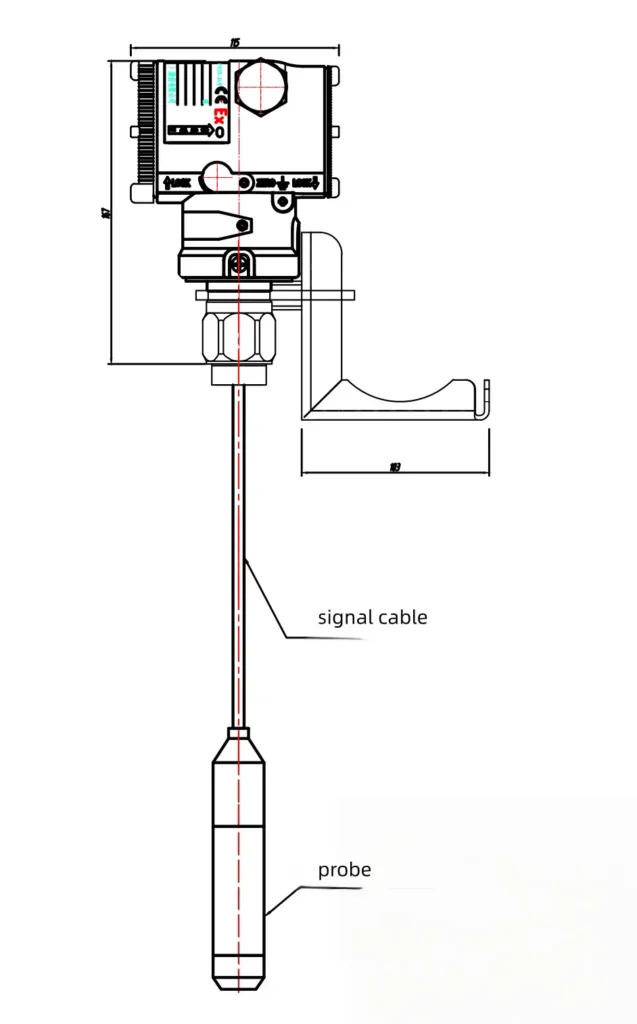
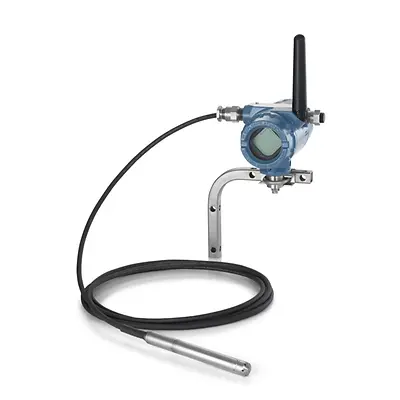
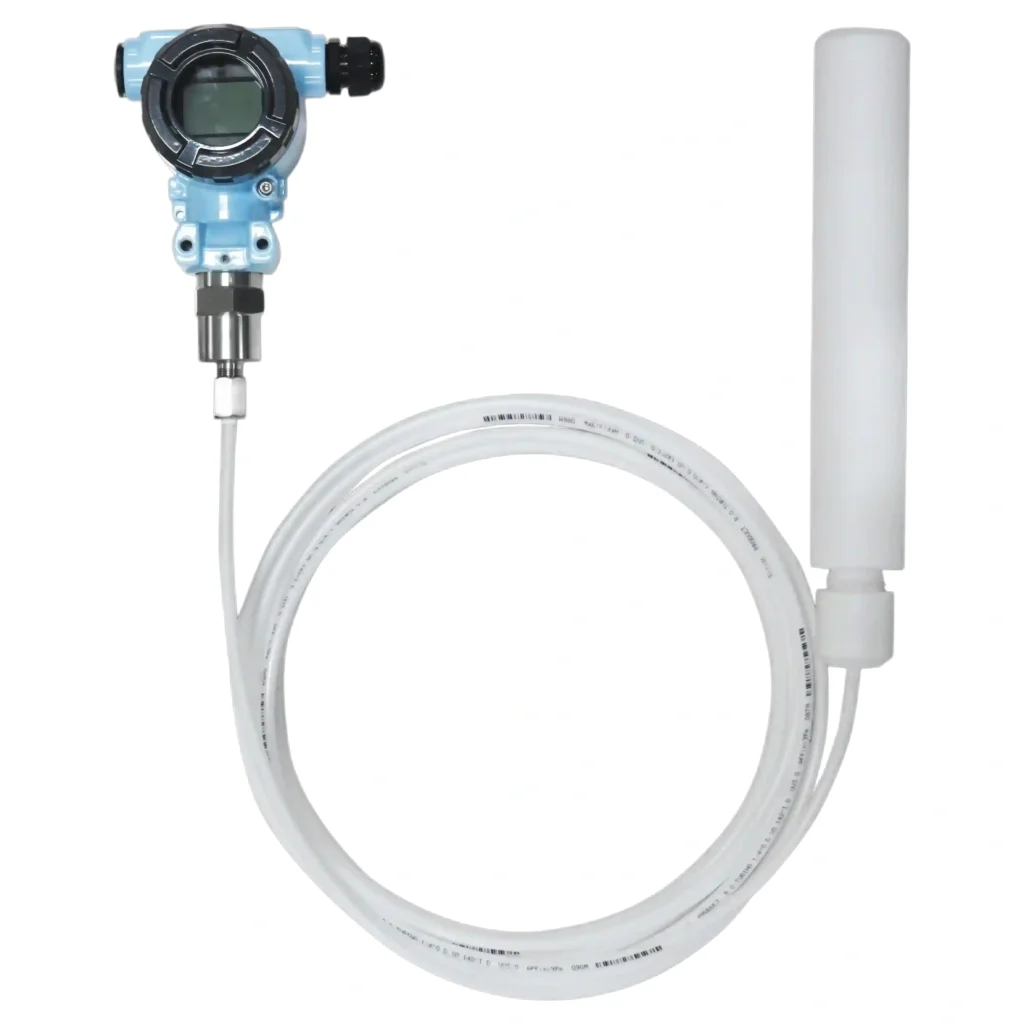
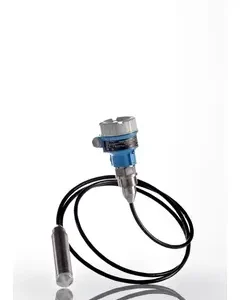
Although a submersible level transmitter looks simpler than a differential pressure transmitter, it still consists of several key components. A mature and reliable submersible level transmitter usually includes the following parts:
1). Housing head or electronics module
This part is used for signal processing, temperature compensation, output conversion, and local display. It usually adopts a 2088-style or 3051-style housing structure, giving it a more industrial appearance and making field wiring and mounting easier.
2). Probe body
The probe is the core component that directly contacts the liquid. It is usually made of stainless steel, or anti-corrosion materials such as PTFE can be selected according to the corrosiveness of the medium.
3). Pressure sensor element
This is the core measuring component of the level transmitter, responsible for converting the hydrostatic pressure sensed by the probe into an electrical signal. Common solutions include diffused silicon and piezoresistive structures.
4). Isolation diaphragm
The isolation diaphragm is used to separate the measured medium from the internal sensing element, preventing corrosion or contamination of the sensor. Common materials include 316L, while more corrosion-resistant options can be selected according to the application.
5). Vented cable
The vented cable not only transmits the signal, but also performs atmospheric pressure compensation through its internal venting structure, making it a very critical part of a submersible level transmitter. Cable quality, sealing performance, and weather resistance all directly affect long-term stability.
6). Sealing structure
This is mainly used to prevent liquid, moisture, or water vapor from entering the probe or cable terminals. For long-term immersion, humid, or outdoor environments, sealing performance is extremely important.
7). Electrical connection and terminals
These are used for power supply and signal output connection. A display module is usually included, and some products adopt an explosion-proof wiring structure for easier field installation.
8). Mounting accessories
Accessories such as brackets, clamps, matching flanges, fasteners, and gaskets can be selected according to field conditions.
3. What Media Are Suitable for a Submersible Level Transmitter?
A submersible level transmitter is mainly suitable for continuous level measurement of liquid media, especially in applications where non-contact measurement from the tank top is not convenient, or where a directly immersed probe is more suitable.
Common applicable media include:
Various clean liquids
- Tap water
- Pure water
- Groundwater
- Circulating water
- Cooling water
- Firefighting water
General industrial liquids
- Industrial wastewater
- Sewage
- Sedimentation tank liquids
- Reclaimed water
- Condensate
- General chemical liquids
Certain corrosive liquids
For mildly or moderately corrosive liquids, measurement can be achieved by selecting PTFE probe material, PTFE cable material, and anti-corrosion structures.
Deep well, pool, and hydrological level measurement
Submersible level transmitters are highly suitable for deep wells, well shafts, pits, channels, and reservoirs, because these applications often involve deeper measurement depths, limited installation space, and are better suited to bottom-immersed measurement structures.
However, it should be noted that submersible level transmitters are not suitable for every application. For example:
- High-temperature liquids
- Strongly corrosive media
- Media that are prone to crystallization or severe buildup
- High-pressure sealed tanks
- Hygienic food and pharmaceutical applications
In these cases, single flange level transmitters, dual flange differential pressure level transmitters, or radar level meters are often more appropriate solutions.
4. Working Principle of a Submersible Level Transmitter
- P= pressure of the liquid column
- ρ= liquid density
- g= gravitational acceleration
- h= liquid level height
- 4–20 mA
- 4–20 mA + HART
- RS485 / Modbus
- 0–10 V / 0–5 V
5. Typical Applications of a Submersible Level Transmitter
Submersible level transmitters are very common in industrial and municipal applications. Typical uses include:
- Water treatment pool level monitoring
- Sewage well and lift station level control
- Water storage tank and fire water tank level monitoring
- Deep well water level measurement
- River, reservoir, and hydrological monitoring
- Continuous level indication in industrial tanks
- Chemical liquid storage pool level measurement
- Buried liquid container level monitoring
- Cooling tower and circulating system level monitoring
For open containers, atmospheric liquid storage systems, wells, and pools, submersible level transmitters are often a very common and mature solution.
Submersible Level Transmitter Product Technology
1. Technical Specifications of Submersible Level Transmitters
| SIY201 Submersible Level Transmitter Selection Sheet | ||
| 10 | Transmitter Type | |
| 201 | Submersible Level Transmitter | |
| 20 | Product Type | |
| 1 | Hydrostatic Type | |
| 2 | Stainless Steel Pressure-Guided Type | |
| 3 | PTFE Pressure-Guided Type | |
| 30 | Accuracy | |
| -H | Basic Error +/-0.2% | |
| -N | Basic Error +/-0.5% | |
| 40 | Measuring Range (Span / Minimum Span) | |
| XX | Specified range height, from 0-1 to 15 mH2O (e.g. 2 mH2O: 02) | |
| 50 | Communication Protocol | |
| A | 4-20 mA Output | |
| H | 4-20 mA / HART Output | |
| F | 0-5V | |
| V | 0-10V | |
| Y | Other Specified Communication Protocol | |
| 60 | Diaphragm Material | |
| 2 | 316SST | |
| 5 | Tantalum | |
| 7 | Ceramic Diaphragm (99.9% AL2O3) | |
| 0 | Customer-Specified Diaphragm Material | |
| 70 | Process Mounting | |
| B | Bracket Mounting | |
| F | Flange Mounting | |
| X | Other Specified Connection Type | |
| 80 | Probe / Sealing Material | |
| 1F | Vent Tube Cable | |
| 3F | Stainless Steel Cable Type | |
| 4F | Rigid Rod Type | |
| 9F | Anti-corrosion PTFE | |
| 0 | Other Specified Special Requirement | |
| 90 | Cable Length | |
| LXX | Specified cable length (e.g. 2 m: 02) | |
| 100 | Indicator | |
| N | None | |
| L | LCD Display (-20 degC) | |
| O | OLED Display (-40 degC) | |
| 110 | Housing Material / Electrical Connection | |
| B | Aluminum Alloy Housing, Electrical Connection M20 x 1.5 | |
| S | Aluminum Alloy Housing, Electrical Connection 1/2 NPT | |
| C | Stainless Steel Housing, Electrical Connection M20 x 1.5 | |
| T | Stainless Steel Housing, Electrical Connection 1/2 NPT | |
| Y | Other Specified Housing Material or Electrical Connection | |
| 120 | Mounting Bracket Option (only available when ‘Bracket Mounting’ is selected) | |
| N | None | |
| 1 | Galvanized Carbon Steel Bracket | |
| 2 | Stainless Steel Bracket | |
| 130 | Hazardous Area Approval | |
| E5 | ExiaⅡCT4 | |
| K5 | ExdⅡCT4-CT6 | |
| 140 | Other Options | |
| Q4 | Factory Calibration Certificate | |
| Q3 | Third-Party Calibration Certificate | |
| J1 | NAMUR NE43标准 | |
| J3 | Built-in Lightning Protection Module | |
| Note: Please contact the sales representative for special options | ||
2. How to Choose the Right Submersible Level Transmitter?
Although a submersible level transmitter looks simple in structure, proper selection requires consideration of at least the following factors:
1). Medium properties
First, confirm what liquid is being measured, whether it is corrosive, whether it contains impurities, sludge, particles, or sediment, and whether it easily adheres to the probe surface.
- Clean water and general industrial water: a standard 316L probe is usually sufficient
- Wastewater or media with many impurities: anti-clogging and anti-buildup capability should be considered
- Corrosive liquids: anti-corrosion probe and anti-corrosion cable should be selected
- Special chemical liquids: other level measurement solutions may need to be considered instead of continuing to use a submersible type
2). Pressure
Submersible level transmitters are usually used in open tanks, so they are almost always used under atmospheric pressure conditions. If the tank is sealed, other types of level measurement instruments are usually required, such as dual flange differential pressure level transmitters or radar level meters.
3). Measuring height
Liquid level height determines the required range and also affects the cable length selection.
Usually, the selected range should be slightly greater than the actual maximum liquid level height.
4). Liquid density
Submersible level transmitters calculate level based on hydrostatic pressure, so liquid density directly affects the measurement result. For water-based media, selection is relatively simple. For liquids with significantly different densities, the density should be clearly specified when ordering.
5). Temperature
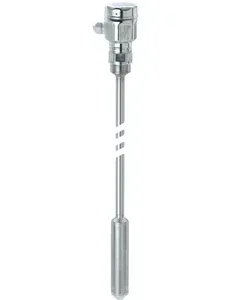
Standard submersible level transmitters are suitable for media temperatures below 80°C. If the temperature is too high, sealing performance, sensor stability, and cable life will be affected. For high-temperature applications, a stainless steel rod-type structure should be selected.
6). Process connection
Submersible level transmitters are usually fixed by bracket mounting or flange mounting. Whether using a bracket or flange, it mainly serves as a fixing method and has almost no direct effect on the transmitter’s measurement itself.
7). Whether display and communication are required
If local indication of liquid level is needed, a version with display head can be selected. If the transmitter is connected to a PLC or remote system, 4–20 mA, HART, or RS485 output can be selected according to system requirements.
8). Whether explosion-proof, anti-corrosion, or special mechanical protection is required
In chemical, flammable, explosive, or strongly corrosive environments, explosion-proof requirements and material requirements must be confirmed in detail. A standard type should not be used directly in high-risk environments.
3. Selection Suggestions for Special Operating Conditions
Wastewater and impurity-containing liquids
Priority should be given to anti-clogging performance of the probe, resistance of the cable to contamination, and the structure of the probe bottom, to avoid long-term operation problems caused by sludge buildup. If the medium contains impurities, a filter screen should be considered at the probe location.
Corrosive liquids
When the medium is corrosive, it is not only the probe material that needs to be corrosion-resistant. The diaphragm, cable outer jacket, and sealing parts must also be confirmed as suitable for the medium.
Deep well measurement
For deep well applications, the focus is not only on the range, but also on cable strength, long-term immersion reliability, venting system stability, and installation fixing method.
Highly fluctuating or agitated conditions
If the liquid surface fluctuates, churns, or is strongly agitated, a submersible level transmitter can still be used, but the installation location should avoid direct liquid impact areas to reduce measurement fluctuations.
Installation and Maintenance of Submersible Level Transmitter
1. How to Install a Submersible Level Transmitter?
Although the installation of a submersible level transmitter is simpler than that of a dual flange differential pressure level transmitter, it does not mean that the probe can simply be dropped into the liquid. Proper installation helps improve long-term stability and extend service life.
Typical installation principles
- The probe should be immersed vertically into the liquid as much as possible
- Avoid liquid inlet, outlet, pump suction point, and agitator areas as much as possible
- Prevent long-term collision or friction between the probe and the tank wall
- The probe bottom should not rest directly on the tank bottom or pool bottom
- The cable should be firmly fixed to avoid its own weight pulling on the terminals for a long time
- The end of the vented cable and the junction box must be well protected against moisture and water ingress
Common installation methods
- Direct immersion type
Suitable for common applications such as water pools, wells, and liquid storage pools, and it is the simplest installation method.
- Pipe or guide tube installation
Suitable for conditions with significant liquid level fluctuation or when the probe position needs to be fixed, reducing probe movement.
- Flange-mounted type
Suitable for installation through an opening on the top of a tank, making positioning and maintenance easier.
2. Installation Precautions for a Submersible Level Transmitter
In actual projects, many submersible level transmitters fail not because of the sensor itself, but because of installation details.
Particular attention should be paid to the following points:
- The vented cable must not allow water ingress
This is one of the most common problems with submersible level transmitters. Once moisture enters the venting channel, measurement stability will be directly affected. - The junction box and terminals must be sealed
Especially in outdoor, wellhead, or underground humid environments, waterproof sealing is even more important. - A proper distance should be maintained from the tank bottom
The probe should not directly touch the bottom of the tank or pool, otherwise it may be buried or clogged by sediment. - Avoid installation in strong impact areas
Such as near liquid inlets or pump outlets, where local pressure disturbances can occur. - Signal cables should be kept away from strong electrical interference
Especially near frequency converters or power cables, shielding and proper wiring should be considered.
3. How to Calibrate a Submersible Level Transmitter?
As a manufacturer of submersible level transmitters, all products produced by Siye Electric are calibrated before leaving the factory. On site, the main tasks are installation inspection and zero point confirmation.
Common on-site inspection methods
- Check whether the power supply is normal
- Check whether the output signal is correct. Before the probe enters the tank, it should output 4 mA
- Verify the display value or output value under known liquid level conditions
- Perform zero adjustment if necessary
- Check parameters for models with display or communication functions
If strict calibration is required, it should usually be carried out with a standard pressure source, calibration instrument, and signal testing equipment. For applications with high accuracy requirements, calibration is better performed at the manufacturer’s facility or in a professional laboratory.
4. How to Maintain a Submersible Level Transmitter?
The mechanical structure of a submersible level transmitter is not complicated. Daily maintenance mainly focuses on the probe, cable, and sealing.
- Regularly check whether the probe surface has dirt, scale, or sediment buildup
- Check whether the cable jacket is worn, cracked, or aged
- Check whether the junction box sealing is reliable
- Regularly verify whether the output signal is stable
- Clean the probe regularly in wastewater applications
- For long-term immersion applications, regularly check whether fixing points and support parts are secure
- If the field medium is dirty or contains a lot of silt, the maintenance frequency should be increased accordingly.
Submersible Level Transmitter Comparison
1. Submersible Level Transmitter vs Single Flange Level Transmitter
Both submersible level transmitters and single flange level transmitters are used in atmospheric applications and cannot be used in pressurized conditions.
A single flange level transmitter is usually installed on the side or bottom of a tank, sensing the hydrostatic pressure of the liquid through a diaphragm. It is more suitable for applications with stricter process connection requirements, sanitary requirements, or clear flange installation conditions.
In comparison, a submersible level transmitter is generally installed from the top of the equipment. Its advantages are simpler installation and lower cost, making it more suitable for wells, pools, open containers, and general liquid storage systems.
When to choose a submersible level transmitter
- Atmospheric open pools
- Deep wells and underground pits
- Limited installation space
- Installation position at the top of the tank
- Desire for simpler structure and lower cost
When to choose a single flange level transmitter
- The tank has a defined flange connection
- Installation position is at the tank bottom
- Medium temperature is higher or corrosiveness is greater, where a single flange level transmitter is more suitable than a submersible level transmitter
- Specific sanitary or structural requirements exist
2. Submersible Level Transmitter vs Float Level Transmitter
A float level transmitter relies on a float moving with the liquid level, and most are mechanical or switch-output devices. A submersible level transmitter is a continuous level measuring instrument.
Advantages of a submersible level transmitter
- Can output a continuous signal
- Usually provides higher accuracy
- No obvious mechanical transmission parts
- Better suited for remote transmission and automation system integration
Advantages of a float level transmitter
- Intuitive structure
- In some applications, no power supply is required
- May be lower cost for simple level control
If continuous level indication and remote transmission are required, a submersible level transmitter is usually more suitable. If only simple high/low-level switching is needed, a float level transmitter may be more appropriate.
3. Submersible Level Transmitter vs Radar Level Transmitter
A radar level transmitter is a non-contact measuring instrument installed on the top of the tank. It measures level by transmitting and receiving microwaves. Since it does not contact the medium, it is suitable for many complex applications. It calculates level by measuring the distance between the liquid surface and the tank top, so the total tank height must be known.
A submersible level transmitter, by contrast, must be immersed into the medium and calculates the liquid level based on hydrostatic pressure.
Advantages of a submersible level transmitter
- Usually lower in cost
- Convenient for deep wells, water pools, and similar applications
- Direct measuring principle
- High cost performance for ordinary liquid applications
Advantages of a radar level transmitter
- Non-contact measurement
- Suitable for both atmospheric and pressurized applications
- Not affected by probe immersion life due to liquid corrosion
- Better suited for high temperature, steam, sealed tanks, and complex process conditions
- Maintenance does not require removing the probe from the liquid
For ordinary water, wells, and pools, a submersible level transmitter is usually more economical. For high-demand industrial tanks or complex media, a radar level transmitter is generally recommended.
4. Submersible Level Transmitter vs Dual Flange Differential Pressure Level Transmitter
A dual flange differential pressure level transmitter is usually installed on the side of the equipment. It is commonly used in closed tanks, pressurized vessels, high-temperature media, and corrosive media, measuring level through pressure tapping by upper and lower flanges.
In comparison, a submersible level transmitter is more suitable for atmospheric, open, and non-high-temperature, non-high-pressure level measurement, and is installed from the top of the equipment.
Advantages of a submersible level transmitter
- Simple installation
- Lower cost
- No need for upper and lower pressure tapping
- More suitable for water pools, deep wells, and open storage tanks
Advantages of a dual flange differential pressure level transmitter
- Better suited for closed vessels
- Better suited for high-temperature and high-pressure applications
- Better suited for strongly corrosive media or media where direct immersion of the probe is not appropriate
- Better aligned with standardized installation requirements in many process industries
5. Submersible Level Transmitter vs Ultrasonic Level Transmitter
An ultrasonic level transmitter, similar to a radar level meter, is also a non-contact measuring instrument. It is commonly used for open water pools, sewage tanks, and general liquid level measurement. By measuring the distance between the liquid surface and the tank top, it determines the empty space, then calculates the liquid level using:
Tank height – empty height = liquid level height
However, ultrasonic level meters are easily affected by foam and steam, which can reduce measurement accuracy.
Advantages of a submersible level transmitter
- Less affected by foam and steam
- More convenient for narrow well shafts and deep well applications
- Less dependent on installation space and top structure
- More direct measurement principle
Advantages of an ultrasonic level transmitter
- Non-contact measurement
- No need for the probe to be immersed in the liquid
- Convenient installation and maintenance in some clean liquid applications
If the site has heavy foam, steam, or liquid surface reflection disturbance, an ultrasonic level transmitter may be unstable. In such hydrostatic liquid measurement applications, a submersible level transmitter is often more direct.
6. When Is a Submersible Level Transmitter the Better Choice?
A submersible level transmitter is usually worth prioritizing when the following conditions are met:
- Atmospheric or open container
- Level measurement in water pools, tanks, deep wells, rivers, etc.
- The liquid medium is suitable for contact measurement
- Moderate cost is desired
- A simple installation structure is preferred
- Continuous level remote transmission signal is required
- Top-mounted non-contact level measurement is not suitable
OEM Service, Price, and Quotation Information of Submersible Level Transmitter
1. Why Choose Our Submersible Level Transmitter?
A submersible level transmitter may seem like a mature and conventional product, but what really affects the user experience is not simply whether it can measure, but whether it can measure stably over the long term, adapt to complex field conditions, and reduce later maintenance issues.
Siye Electric specializes in the R&D and manufacturing of pressure transmitters, with more than 10 years of experience in industrial instrument production. We have long provided stable and reliable pressure measurement products to customers worldwide. The company has mature production processes, strict quality control procedures, and a complete supply chain system. Our products are widely used in water treatment, petrochemicals, energy, power generation, machinery, and automation control industries.
Our submersible level transmitters offer the following features:
Mature structure and stable measurement
Using mature pressure sensor technology and stable signal processing solutions, they can meet the continuous level measurement needs of most industrial applications.
Multiple appearance and structural options
Compact type, 2088-style housing, 3051-style housing, and different installation methods can be selected according to project needs, making it easier to match different customer preferences and field requirements.
Flexible material and cable configuration
According to different media and installation environments, 316L, stainless steel, anti-corrosion probe, standard vented cable, anti-corrosion cable, abrasion-resistant cable, and other options are available.
Support for multiple outputs and display methods
4–20 mA, HART, and RS485 outputs can be provided, with optional local display and customized parameter configuration.
Calibrated and tested before shipment
All products are performance-tested and calibrated before leaving the factory to ensure basic accuracy and stability.
Support for selection service
If the customer’s field conditions are complex, we can provide a more suitable selection recommendation according to the liquid medium, level height, installation environment, and control requirements, rather than simply offering a standard model.
2. Does It Support OEM / ODM Customization?
Yes.
We can provide OEM / ODM services according to customer requirements, helping customers build their own branded product lines. Product structure and documentation can also be customized according to project requirements.
Customizable items include:
- Product nameplate private labeling
- Logo customization
- Model code customization
- Parameter and measuring range customization
- Cable length customization
- Probe material and structure customization
- Packaging customization
- Manual and label customization
For long-term cooperative customers, we can also provide more targeted product configuration and matching solutions according to actual project requirements.
If you are looking for a stable and reliable pressure transmitter manufacturer or OEM supplier, please feel free to contact us. We will provide professional product solutions according to your needs.
3. Price of Submersible Level Transmitter
For a submersible level transmitter with standard measuring range, 304 wetted material, cable length within 5 meters, and 0.25% accuracy, the price is usually around USD 150 per unit, and the standard configuration includes a carbon steel bracket and a stainless steel explosion-proof cable gland.
Please provide your medium, liquid level height, temperature, installation method, and signal requirements, or send your detailed field conditions to our email. We will provide you with a quotation within one hour.