pressure transmitter shop
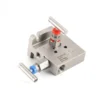
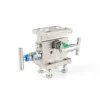
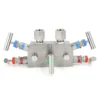
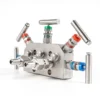
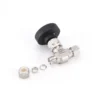
Integral Three Valve Manifold
shop

pressure transmitter shop
Integral Three Valve Manifold
shop
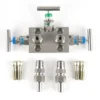
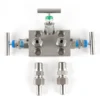
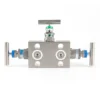
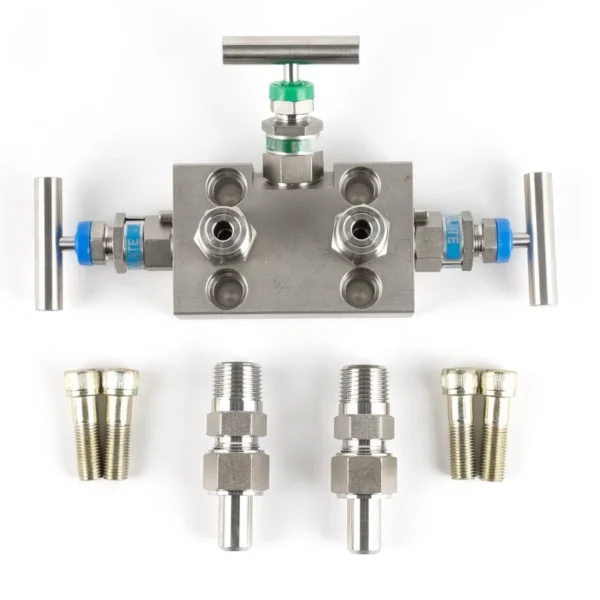
Working Pressure: 6000Psi – 10000Psi(414 Bar – 690 Bar)
Working Temperatures: PTFE packing: -65 °F to 450 °F (-54 °C to 232 °C)
Graphite packing: -65 °F to 1200 °F (-54 °C to 649 °C)
Orifice: 0.157 (4.0 mm)
Inlet/Outlet/Test/Vent: NPT 1/2-NPT 1/4, Flange (optional)
Connection: Pressure Transmitter
The SIYelectric Instrumentation Integral Three Valve Manifold is designed for direct installation with differential pressure transmitters and process pressure instruments in industrial measurement systems.
The integral three valve structure normally includes two block valves and one equalizing valve in one compact manifold body. The two block valves isolate the high-pressure and low-pressure process sides, while the equalizing valve balances pressure across the transmitter during zero checking, commissioning, calibration, or maintenance.
Compared with separate valves and fittings, an integral manifold helps reduce installation space, simplify instrument piping, and minimize potential leakage points. It is widely used in differential pressure measurement, flow measurement, level measurement, filter monitoring, pressure difference monitoring, and process control applications.
Differential pressure and process pressure monitoring
Used in drilling, production, pipeline transmission, gas processing, and refinery systems where DP transmitters are applied for flow, level, or pressure difference measurement.
Flow measurement support
Suitable for differential pressure flow measurement loops using orifice plates, flow nozzles, venturi tubes, and other primary flow elements.
Isolation and equalizing
The integral three valve manifold allows operators to isolate both process sides, equalize pressure across the transmitter, and perform zero checks or calibration more safely.
Process differential pressure measurement
Applied in reactors, pumps, filters, distillation columns, storage tanks, and chemical pipelines where stable differential pressure or pressure monitoring is required.
Safer maintenance in harsh media
The manifold helps isolate instruments from corrosive, toxic, flammable, high-pressure, or high-temperature media before inspection, replacement, or calibration.
Steam and water systems
Used in boiler systems, turbine auxiliary systems, feedwater lines, condensate systems, and steam pipelines where DP transmitters are used for flow, level, and pressure difference measurement.
Instrument protection and calibration
The three valve structure helps protect the transmitter during commissioning, shutdown, zero adjustment, and routine calibration work.
Clean utility and auxiliary process lines
Suitable for auxiliary differential pressure measurement in water systems, clean utility lines, filtration skids, fermentation equipment, mixing systems, and process skids.
Clean process isolation
For hygienic or sanitary applications, material selection, connection type, sealing structure, and surface requirements should be confirmed according to the actual medium and cleaning conditions.
Flow and differential pressure monitoring
Used in filtration systems, pumping stations, membrane systems, treatment equipment, and distribution pipelines to support stable pressure and differential pressure measurement.
Filter pressure drop measurement
Suitable for monitoring differential pressure across filters, membranes, and treatment units, helping operators identify clogging, fouling, or maintenance requirements.
Differential pressure measurement
Applied in chilled water, heating water, air handling units, filter sections, pump systems, and heat exchangers where pressure difference needs to be monitored.
Maintenance isolation
The manifold allows technicians to isolate and equalize the transmitter locally, making inspection, zero adjustment, and replacement more convenient.
Controlled DP measurement lines
Used in laboratories, test benches, pilot plants, and research systems where gases or liquids require stable differential pressure monitoring.
Compact instrument connection
The integral manifold body supports transmitter mounting, pressure balancing, isolation, calibration, and pressure line management in experimental or small-scale process systems.
Request Your Custom Solution & Factory Price
*We respect your privacy. Your information is used for technical quotation purposes only and will never be shared.
We use cookies to improve your experience and analyze site traffic. Choose which cookies you allow.
Required for the website to function. Cannot be disabled.
Help us understand how visitors interact with the website.
Used to deliver relevant advertisements and track campaigns.
No marketing cookies are used on this site.
Remember your settings and preferences for a better experience.
No preference cookies are used on this site.